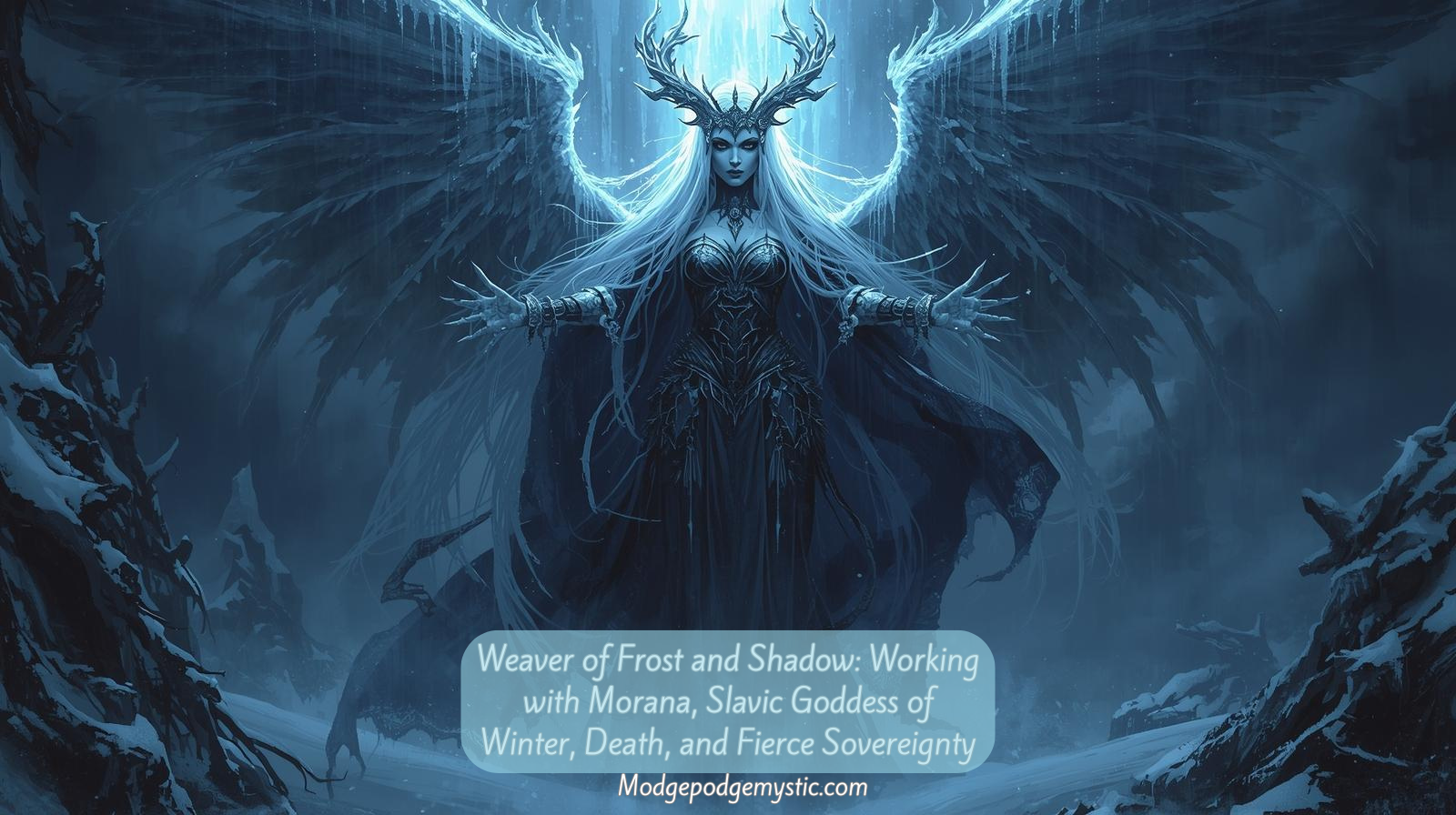
In the deep hush of the ancient Slavic lands, where the air bites with frost and the forests stand skeletal, a primal energy reigns. This is the domain of Morana (or Mara, Morena, Marzanna), the Slavic Goddess of Winter, Death, Rebirth, and the liminal veil. She is the fierce, uncompromising sovereign of the frozen world, a figure often misunderstood as purely malevolent, yet whose power is essential for the cycle of existence. Morana is the necessary end that ensures a new beginning, the chilling stillness that prepares the soul for spring’s explosion.
For the modern witch and pagan, working with Morana is a profound journey into shadow work, self-mastery, and the courageous acceptance of life’s most final truths. She guides us in the powerful magic of release, severing what is dead, and claiming the cold, fierce strength that only winter can bestow. She is the Dread Queen of the Snows, and her wisdom is as sharp as an icicle.
Who is Morana? The Goddess of the Sacred End
When the light recedes, the harvest is gathered, and the earth hardens under a mantle of ice, it is Morana who is whispering through the winds. She is a deity of duality, commanding the season of winter, the finality of death, the mysteries of the underworld, and the vital spark of spiritual rebirth.
Morana is the embodiment of the cyclical nature of existence. She holds dominion over the darkest half of the year, governing the cessation of life that makes way for the fertile awakening of Spring. She is known as the bringer of frost, the creator of the winter stillness, and the keeper of the gates between the worlds.
Morana isn’t just a figure of doom; her origins tie her to ancient Slavic traditions where the death of the old year (and the goddess) was a sacred, vital act performed to guarantee the return of life. She represents the unyielding truth that all things must end. By embracing her, we learn the power of letting go and the fierce sovereignty found in confronting the shadow.
Morana, Deity of Death, Winter, and the Shadow Self
Morana’s names—Mara (from an Indo-European root meaning ‘death’) or Marzanna (perhaps tied to ‘mors’ or ‘freezing’)—underscore her primal connection to the final breath and the frozen season. She is not cruel, but she is uncompromising.
As Goddess of Winter: Morana arrives when the sun god, Svarog, weakens. She blankets the world in snow, forcing introspection, stillness, and conservation of energy. This stillness is a powerful lesson in non-action and inner wisdom.
As Goddess of Death and Rebirth: She governs the passage of souls and the necessary decay of the material world. To work with Morana is to work with the magic of release—cutting ties to old wounds, habits, and relationships that no longer serve. Her power is the scythe that prunes the dead wood so that the living may flourish.
As a Dark Feminine Archetype: Morana represents the untamed, sovereign feminine that refuses to be softened or subdued. She is the Queen who needs no validation, standing in the purity of her own formidable power. She is the shadow self, the cold wisdom, and the ultimate truth-teller.
Myths, Legends, and the Rite of Drowning
Morana’s most enduring myth is less a tale and more a sacred, annual rite—her ritual death by fire and drowning at the start of spring (often around the Spring Equinox/Ostara).
In Slavic lands, Morana (often embodied as an effigy or straw doll, dressed in white or dark rags) is paraded through the village and then violently destroyed—burned, torn apart, or, most famously, drowned in a river. This act is not born of hatred, but of a deep, primal understanding of cyclical magic:
The Death of Morana is the Birth of Spring.
Her sacrifice cleanses the land of the previous year’s ills, plagues, and, crucially, the harsh grip of winter. Her effigy absorbs the accumulated darkness, and by sending her (and it) away, the Slavs ceremoniously ushered in Vesna (the spring goddess).
This myth teaches the witchcraft principle of transference and release. We intentionally load what we wish to be rid of onto an object or thought-form, and then destroy it. Morana is the ultimate figure of letting go so that evolution can occur.
Familial ties and Cosmic Balance
In the complex weave of the Slavic pantheon, Morana is often seen as:
Daughter of Lada and Svarog: Placing her among the primary, cosmic deities.
Wife/Consort of Chernobog (The Black God): Solidifying her role as a dark, chthonic force and partner to the primordial god of chaos and shadow, emphasizing the necessary balance of light and dark.
Sister to Yarilo/Jarilo (God of Spring): This kinship powerfully reinforces the cycle. Morana’s death ensures her brother’s vibrant return, demonstrating a divine balance where one cannot exist without the other.
Correspondences for Morana
Correspondences are the magical language used to invoke, honor, and connect with a deity’s specific energy. Trust your intuition above all when selecting items for her altar or rituals.
Death (XIII), The High Priestess (II), The Hanged Man (XII)
Timing
Waning Moon, New Moon, Midnight
Signs Morana May Be Calling You
The call of Morana is rarely gentle; it is a primal urge, a chill that settles in your spirit. If you feel drawn to her, it is likely you are in a season of profound, necessary change. Here are signs she may be reaching out:
You are experiencing a life-shattering ending—a job, a relationship, or a painful identity shift.
You feel a powerful, internal pull toward shadow work and confronting your deepest fears.
You are fascinated by the cycles of death, decay, and transformation.
You feel a strong affinity for the winter season, its silence, and its stark beauty.
You consistently hear or see her name, or are drawn to her associated colors (black, white, icy blue).
You are struggling to maintain fierce boundaries and need the strength to say No and let things go.
She appears in your dreams as a regal figure of ice, a figure by a frozen river, or a silent, dark presence.
Ways to Work With and Connect To Morana
Connecting with Morana requires respect, courage, and a willingness to step into the darkness. She is a powerful ally for the witch dedicated to self-sovereignty and transformative magic.
Practice Active Release: During the winter, write down a habit, fear, or past wound you wish to release. Place the paper in a jar of water and freeze it, symbolically binding it in Morana’s icy grip. When spring arrives, melt the ice and pour the water into the earth far from your home.
Deep Shadow Work: Invoke Morana to guide you through your inner landscape. Ask her to be the scythe that cuts away self-deception and what holds you back. Use obsidian or black tourmaline during your meditations.
Honoring the Rite of Drowning (Symbolically): At the transition from winter to spring, create a small, temporary altar (perhaps with pine needles and ice) and thank her for the lessons of winter. Then, ritually pack it away to welcome Vesna.
Consecrate Boundary Magic: Ask Morana to charge your wards and protective spells. Her energy is uncompromising and excellent for establishing clear, cold lines of demarcation.
Divination in the Dark: Use a black scrying mirror or a bowl of water under the New or Waning Moon to seek her cold, unvarnished truth about a situation.
Create a Winter Altar: Dedicate a space during the cold months with her colors, a bowl of snow or ice (if safe), pine branches, and a plain black or white candle.
Offerings for Morana
Morana favors offerings that reflect her cold, stark, and elemental nature.
Black or White Candles (especially during the darkest part of the year)
Pieces of Ice or a small bowl of fresh, clean snow.
Willow, Pine, or Cypress Branches/Needles.
A simple Mirror (symbolizing her reflection of truth).
Onyx, Jet, or Obsidian stones.
Dark Wine (spilled or poured outdoors where permitted).
Quiet contemplation and a vow to face a painful truth.
Sovereignty Ritual: The Cold Acceptance
This ritual is for those ready to face a painful truth, release a stagnant attachment, or sever a tie that is draining their vital energy.
Materials:
One black candle.
A piece of paper and a pen.
A small, fire-safe bowl.
A protective crystal (like Black Tourmaline).
A bowl of water or ice.
Steps:
Purify and Ground: Light the black candle and hold the crystal, placing the bowl of water/ice nearby to invoke Morana’s element. Take a moment to settle into the sacred space.
Invoke Morana: “Morana, Dread Queen of the Snows, Keeper of the Scythe, I invite your fierce, uncompromising truth. Grant me the cold courage to sever what must end.”
The Severance: On the paper, clearly write the thing you must release (a fear, a person’s influence, a toxic habit, a limiting belief). Be brutally honest.
The Vow: Hold the paper near the candle flame (do not light it yet) and state your vow: “I accept the necessity of this ending. I release [the written item]. Morana, give me the strength to let this go and claim the fertile stillness it creates.”
Release by Fire: Carefully light the paper from the candle flame and drop it into the fire-safe bowl, watching it burn to ash. As the last embers glow, say: “It is done. It is ended. I am sovereign.”
Integration: Look at the water/ice, thanking Morana for her cold clarity. Extinguish the black candle. Carry the ashes outdoors and return them to the earth, the ultimate cycle of decay and rebirth.
Solstice Magic: Morana’s Deepest Stillness Ritual
The Winter Solstice, or Yule, marks the longest night of the year and the symbolic peak of Morana’s reign. This is the moment of deepest stillness, where the Earth pauses, allowing us to descend into radical introspection and prepare the soil for eventual return of light. This ritual is designed to honor the dark and harness the power of Morana for spiritual conservation and necessary release before the wheel turns.
Materials
Black Candle: To symbolize the darkness and Morana’s reign.
An Offering: A small bowl of fresh snow, ice, or dark, strong-smelling herbs (like cypress or pine needles).
A Container for Release: A small glass jar or a piece of slate/stone.
Paper and Pen: Black paper or dark ink is ideal.
A Personal Symbol of Sovereignty: A piece of jewelry, a ring, or a small crown to be charged.
The Rite of Deep Winter
Purify and Cast the Circle: On the night of the Solstice, cleanse your space and cast your circle according to your tradition. Light the black candle, placing it centrally on your altar.
Invocation: Stand before the altar and feel the cold energy of the season settling in your bones. Speak to Morana:“Morana, Weaver of Frost and Shadow, Queen of the Deep Night. I honor your sovereignty and your uncompromising truth. On this longest night, I seek the stillness that precedes rebirth. Guide my gaze into the essential dark.”
The Stillness Meditation: Sit before the candle. Gaze into the flame, then close your eyes. Visualize the world blanketed in deep, silent snow. Feel the need to conserve energy. Ask yourself:
What unnecessary noise, activity, or attachment must I let freeze and fall away?
What is the core, essential truth that remains when all else is stripped away?
The Release: Open your eyes. On the dark paper, write down one or two things you are consciously choosing to release and leave behind in the dark year—a pattern, a limiting belief, or a draining relationship. Write it clearly and unequivocally.
Entrusting to the Frost: Fold the paper and place it into the jar or under the stone. Say:“I entrust this burden (or pattern) to Morana’s freeze. It is dead. It is done. It will not cross the threshold of the returning light.”
Charging the Sovereignty: Take your personal symbol of sovereignty. Hold it above the black candle flame (safely!) and then touch it to the bowl of ice or snow. Say:“May the cold clarity of Morana infuse this (item). May I wear her sovereignty, her fierce boundary, and her silent, unyielding power throughout the turning year. I am the sovereign of my own life.”
Closing: Leave the black candle to burn down completely (safely, if possible), or extinguish it to be relit until the end of the Solstice period. Thank Morana for her wisdom and release the circle. Leave the jar or stone on your altar until the spring equinox.
Spell of Morana’s Icy Barricade: Setting Unyielding Boundaries
Morana is the master of absolute boundaries—the frost line that kills what cannot survive and the icy barrier that holds back the spring until the exact moment of power. This spell harnesses her uncompromising energy to create a strong, clear, and cold psychic barrier around you or your sacred space.
Morana’s Ingredients for Protection
A Small Vial, Black Cloth Bag, or Salt Jar: The vessel for the spell.
Salt: Black salt, rock salt, or coarse sea salt for absorption and defense.
A Sharp Thorn or Pin: To symbolize cutting, severance, and the point of contact (you can substitute a small piece of obsidian).
Pine Needles: For ever-green protection and conservation.
Willow Bark or Cypress: To banish and represent connection to the dead/underworld.
A Piece of Paper with a Sigil: Draw a simple sigil representing “Unyielding Boundary” or “No Trespassing.”
The Spellcasting: Creating the Barricade
Preparation: Assemble your ingredients on your altar, focusing on the dark, clear, and cold energy of Morana. Hold the vessel (vial or bag) and visualize it becoming a piece of unbreakable, opaque ice.
Infusing the Salt: Take the salt in your hand. Feel it drawing all scattered energy inward. Say:“Salt of the Earth, cold and deep, bind all that would seek to creep. May this become the foundation of Morana’s keep.”
Layering the Protection: Add the ingredients to the vessel in layers, focusing on their protective qualities:
Add the Pine Needles and Willow/Cypress:“May what drains me freeze and fall away.”
Add the Thorn/Pin/Obsidian:“May any intrusion find a sharp and swift retreat.”
Place the Sigil inside: “I seal the perimeter of my will. My boundary is unyielding.”
The Invocation and Charge: Seal the vessel (tie the bag, cap the vial). Hold it between your hands and raise it over your black candle. Close your eyes and visualize a wall of shimmering, obsidian ice forming around you, reflecting all unwanted energy back to its source.“By the power of Morana, Queen of the Winter and the Severing Scythe, I charge this Icy Barricade. No energy, no intent, no word, and no person shall cross the line I draw, unless invited by my sovereign will. This boundary is sharp, cold, and absolute. Sovereignty is held. So it is sealed.“
Placement: Place the finished Icy Barricade near your front door, in your office, or carry it with you to enforce powerful, necessary boundaries in your daily interactions.
Why Work with Morana?
Morana’s magic is not about sweetness or comfort; it is about unyielding self-sovereignty. She teaches that there is profound power in the ability to let go, to stand in the stillness of winter, and to recognize that every ending is a sacred, necessary precondition for the next beginning.
She is the ultimate patron for the witch who is ready to stop being defined by what others want and instead embrace their own fierce, uncompromising, and powerful truth. She reminds you: You are not what you carry; you are the sovereign who chooses what to release.
I am Kayreign, the Divine Oracle of the Gods and Keeper of Mysteries, a solitary grey magic practitioner with over 15 years of experience walking the sacred paths of the unseen. As a mystic and relentless seeker of all knowledge, I weave together the threads of every magical tradition—light and dark, ancient and modern—to uncover the universal truths that bind us to the cosmos. My mission is to restore and re-enchant magic in this realm, igniting its spark in every soul I encounter, and guiding you to embrace the full spectrum of your being.
My work is rooted in the power of duality, honoring the dance between shadow and light as equal partners in your spiritual journey. I hold space for you to explore all magic paths and practices, drawing from the vast tapestry of mystical wisdom to help you uncover your unique magic and sacred contracts. As the Divine Oracle of the Gods, I channel divine insights to illuminate your path; as the Keeper of Mysteries, I guide you into the depths of the unknown, where true transformation awaits.
When you work with me, you’ll learn to live in energetic balance, embracing your darkness as a source of power, not just a stepping stone to the light. I’ll hold up a mirror to reflect your authentic self—unmasked, raw, and whole—inviting you to face your past wounds, traumas, and hurts with courage. Together, we’ll alchemize every chapter of your story, dark and light, into a blazing internal flame that lights your way on even the coldest nights. Through this process, you’ll find alignment with your purpose, release what holds you back, and step fully into your power.
Come join me for community, knowledge, and to restore the enchantment of magic in yourself and life today!
As the days draw short and the nights grow long, there are celebrations as well as a tinge of fear in the cold, crisp air as the wild hunt stampedes across the sky on winter solstice night. One of the most popular celebrations honoring the winter solstice was Yule Yule is one of the oldest winter solstice festivals, With roots that intertwine Celtic, Druidic, and Norse traditions from thousands of years ago. Yule is a celebration of the dark stillness of winter and the rebirth of the sun. This ancient celebration marks the point at which the night is longest, the day is shortest, and the journey back toward light begins. the winter solstice offers an opportunity to honor nature’s cycles, reflect on the dark season, and celebrate the sun’s return. Like most winter solstice festivals, themes of light, fire, and feasting are common threads. In Norse culture, the winter solstice was known as Yule or Jol, a festival. It was believed that during this time, the sun goddess Sol gave birth to a new sun, marking the beginning of longer days and the end of winter darkness. Yule offers a beautiful opportunity to honor the cycle of nature, embrace the winter season, and welcome the returning light. Join me on a walk through the crisp winter air, to the feel the snow on your cheeks until you reach the Yule bonfire on Winter solstice night.
What is the winter Solstice?
The Winter Solstice occurs annually around December 21st in the Northern Hemisphere and around June 21st in the Southern Hemisphere. This is a day when the daylight is diminished and it’s the longest night of the year. Nearly every ancient culture acknowledged or celebrated the Winter Solstice in some aspect. It is a powerful moment in the solar year: The night is at its longest, but immediately after this peak, the light begins to regain its hold again (slowly). The solstice represents death, the absolute darkest moment of the year, but also rebirth and hope. Even as we acknowledge grief, loss, and the death in nature all around us, we know that everything will come back to life again in the spring and summer as it always has.
What is Yule?
Yule was one of the most important festivals in the old heathen calendar. Yule is a midwinter celebration that goes back to (as early as) the 4th century. Yule or Jol is an ancient Germanic holiday season. Some say Yule lasted for 12 days, from the Winter Solstice forward, while others say the festivities lasted an entire two months. From December through January, if we’re looking at a modern calendar. The name Jol is believed to come from a name for Odin himself – JÓLFAÐR, which translates to Yule Father. Yule holds immense significance as a time of transition, rebirth, and renewal. It symbolizes the triumph of light over darkness, as the sun begins its ascent, gradually growing stronger and promising the return of spring. Yule is a celebration of the winter solstice, representing the return of light, the cycle of life, and the interconnectedness of nature and humanity.
Other names for yule
Jól
Jólablót
Jul
Yule time
Yuletide
Other Celebrations of the Winter solstice
Many cultures across earth have developed their own stories, beliefs and practices surrounding the winter solstice. These are just a few examples of the diverse ways the winter solstice has been found across different cultures. Many cultures have the universal themes of rebirth, renewal, and the triumph of light over darkness, symbolizing hope and the promise of a new beginning.
Alban Arthan The winter solstice was celebrated by the Celts as the festival of Alban Arthan, which means “Light of Winter.” It was believed that during this time, the Oak King (representing the waxing year) defeated the Holly King (representing the waning year), symbolizing the triumph of light over darkness. They believed that the burning of the Yule log was a way to symbolize the sun’s return and that the exchange of gifts was a way to honor the gods and ask for their favor in the coming year.
Saturnalia The Saturnalia Festival is an ancient Roman holiday that mainly celebrated the Winter sowing season, as well as honored the god Saturn. The actual dates vary but most scholars agree it was once celebrated between December 17th and the 23rd OR December 25th through the 31st, depending on the calendar that was used. Saturnalia was a jovial time for the entire city of Rome because, everyone in ancient Rome participated in the excitement. Especially what I find to be the most interesting par t of this festival the role reversal when power dynamics were switched. Meaning slaves and servants were now the masters for one day and vice versa.
Chinese winter solstice In Chinese culture, the winter solstice is associated with the concept of yin and yang. It is believed that during this time, yin (representing darkness and cold) reaches its peak, and yang (representing light and warmth) begins to grow, symbolizing the return of light and the gradual transition towards spring.
Blue Christmas (holiday) (Western Christian)
Brumalia (Ancient Rome)
Dongzhi Festival (East Asia)
Inti Raymi (Inca)
Koliada and Korochun (Slavic)
Midwinter Day (Antarctica)
Sanghamitta Day (Theravada Buddhism)
Shabe Yalda (Iran)
Shalako (Zuni)
Uttarayana (India)
We Tripantu (Mapuche)
Willkakuti (Aymara)
Yaldā (Western and Central Asia)
Yule in the Northern Hemisphere (Germanic)
Ziemassvētki (ancient Latvia)
The wild Hunt
Yule was also the time when it was believed the wild hunt would stampede across the skies. This was the night when ancestors visited from the Otherworld, and gods and spirits upon phantom horses rode through the night sky, led by All-father Odin upon his eight legged steed Sleipnir, leading the legendary Wild Hunt! No one wanted to be caught out alone on the road on this night as the ghostly hunting party ripped through the night sky, carrying the souls of the dead to the Otherworld.
Yule a time of renewal, rebirth, and transformation
Yule marks the shortest day and longest night of the year in the Northern Hemisphere. It symbolizes the rebirth of the sun as the days gradually start to lengthen again. Yule celebrates the return of light and the promise of warmth and growth in the coming months. Yule is a time of renewal and transformation, both in nature and within ourselves. It represents the cyclical nature of life, reminding us that even in the darkest times, there is always the potential for light and growth. Yule is a time to shed old patterns, release what no longer serves us, and set intentions for the future.
Yule a liminal time of instrospection
Yule is a time for introspection and reflection on the past year. It provides an opportunity to review personal growth, accomplishments, and challenges, as well as to contemplate the lessons learned and the changes desired for the future. Yule encourages self-reflection, inner work, and setting intentions for personal and spiritual development. One of the best ways to do that is through Shadow work. If you would like to learn more about shadow work you can purchase my eBook here; you can book me for a 1:1 session as your guide here; and you can watch my free class previously taught on it through Divination here.
Yule a time of celebration and family
Yule is traditionally a time of gathering with loved ones, family, and community. It is a time for sharing warmth, love, and gratitude. Yule celebrations often involve feasting, exchanging gifts, and participating in rituals or ceremonies that foster a sense of togetherness and unity. It is a time of joy amongst the darkest, and harshest nights of the year.
Winter solstice, Yule, and duality
Since, I am a grey witch I look for the duality in every single energy I work with including sacred times like the winter solstice and festivals to celebrate it like Yule. Yule embodies a powerful duality by embracing the beauty of darkness while celebrating the promise of light’s return. It reminds us that after a season of long, cold nights and short days, the sun’s return is imminent. Yule recognizes the profound duality of life: the lightness and the dark. Yule is a time to pause in honor of all that’s good, while also holding space for pain. Throughout Yule there is a constant ebb and flow, a dance of duality. Filled with joy and sorrow, Abundance and scarcity, and lastly life and death.
Yule and Santa
We all know about the jolly, white bearded, red suited old man Santa Claus. He permeates the holiday season and Yule is included in that. Santa Claus is connected to Yule, because many aspects of the modern Santa figure, like his gift-giving nature and ability to travel through the sky, are believed to be derived from the Norse god Odin who was associated with the Yule festivities, particularly the “Wild Hunt” legend where he would fly through the sky on his eight-legged horse Sleipnir, delivering gifts to deserving individuals; essentially, Santa is seen as a modernized version of the “Yule Father” figure from ancient pagan traditions. To learn more about all of his history you can check out my class on YouTube with Divination all about here. Plus a blogpost on him will be coming right after this one!
Yuletide “monsters”
Most people have heard of Krampus, but there is a whole legion of Yuletide monsters just waiting to be your friend. Let’s talk about the Icelandic Yule Cat, the Yule Lads, and their leader Gryla the Christmas witch alongside Krampus as well below. Why not add them to your yuletide festivities this year as well
Krampus
First up Krampus! In the chilly shadows of European winter folklore (primarily Germanic), the figure of Krampus emerges, distinct with his horns, terrifying hairy body and sinister snarling face. Krampus is a terrifying winter devil who accompanies Saint Nicholas. Krampus punishes the naughty children with spankings, and sometimes his punishments are so severe he even drowns, eats, or carries them off to Hell. While St. Nicholas (St. Nikolaus in Germany) is famous for giving gifts and rewards to the righteous, it’s Krampus’s job to strike fear into the hearts of the wicked. To learn all about the Christmas devil himself Krampus read my previous blog post here.
the Yule Cat While many of us have cats we love on in our homes, the Yule Cat isn’t one to bring inside and feed catnip to. This cat is something much different than the fluffy feline sun bathing in your window sill. In Iceland, his name is the Jolakotturinn. Which essentially translates to Yule Cat and he is known to accompany the Yule Lads (of whom we will meet shortly) and Gryla the Christmas Witch. In fact, the Yule Cat myth has it that he is the pet of Gryla, the only one to love him.
Does that mean if you meet the Jolakotturinn you should let him in your home? Only if you’re fond of facing terrifying creatures AND ONLY IF you are wearing NEW CLOTHES on Christmas when you open that door. What do new clothes have to do with the Yule Cat? Well, legend has it, he will eat you if you’re wearing old clothes!
the Yule Lads If the Yule Cat wasn’t horrifying enough, let’s move on to the Thirteen Yule Lads that hang about for Iceland’s Christmas. Sadly, Santa Claus doesn’t visit the children in Iceland. But the Yule Lads, Jolasveinar or “Yule Swains”, do! The Yule Lads begin invading Iceland on December 12th, thirteen days before Christmas, and hang around until Christmas Day. Each day one new Yule Lad comes down from his home in the mountains. these Yule Lads are more trollish in appearance and nature than human. And they all take on mischievous, if not downright disturbing, roles like one named Window Peeper. Yes, he looks through windows at the unsuspecting people inside. The rest of the thirteen Yule Lads don’t seem much better either with names like Stubby, Gully Gawk, Door Slammer, and Pot Scraper. And yes, there’s even one named Skirt Blower….. Today it’s believed that if the children are bad, the Yule Lads will give them a potato (raw or rotting). And if the children are good, they will receive a gift from each of the thirteen Yule Swains.
Grýla: The Terrifying Yuletide Witch Gryla is the monstrous troll-woman and Christmas witch of Iceland tradition and lore. She is accompanied by her sons and familiar we talked about above. .Gryla steals down from her domain in the mountains to the towns where the bad children lay asleep in their beds. She carries a large sack with her, so that when she snatches the children up she has a safe place to put them. Sound familiar? A little like Krampus from up above.
12 days of yule
Yule celebrations lasted 12 days, from December 21st to January 1st.. The 12 Days of Yule is a holiday that celebrates the winter solstice and the rebirth of the sun. It is also a time to honor the gods and goddesses, the ancestors, spirits of the dead, and the spirits of nature. Below I break down what each of the 12 days represents listen to your intuition to determine how you want to honor and celebrate each one of them.
Day 1:The first day of Yule is also known as Mother’s Night, and it is a day to honor the female ancestors and the goddesses of fertility, protection, and wisdom. (Dec. 20th)
Day 2: The second day of Yule is the winter solstice, the shortest day and the longest night of the year. It is also the day when the sun is reborn, and the days start to get longer and brighter. This is a day to celebrate the light, the fire, and the sun. (Dec 21st)
Day 3:The third day of Yule is a day to honor the triple goddess, the three aspects of the divine feminine: the maiden, the mother, and the crone. The triple goddess represents the cycles of life, death, and rebirth, and the phases of the moon. (Dec 22nd)
Day 4: The fourth day of Yule is a day to honor the ancestors, the spirits of the departed who have influenced our lives and shaped our heritage. The ancestors can be our blood relatives, our spiritual mentors, or our cultural heroes. (Dec 23rd)
Day 5: The fifth day of Yule is a day to honor the animals, the creatures of the earth, air, and water who share this world with us and provide us with food, companionship, and inspiration. The animals can be our pets, our livestock, our totems, or our spirit guides. ( Dec 24th)
Day 6: The sixth day of Yule is a day to honor the gods and goddesses, the divine beings who rule over the realms of existence and manifest the forces of nature and the aspects of life. The gods and goddesses can be from any pantheon or tradition that you follow or resonate with. ( Dec 25th)
Day 7: The seventh day of Yule is a day to honor the elves, the fairies, the dwarves, and the other hidden folk who dwell in the realms of magic and mystery. The hidden folk are the guardians of nature, the keepers of secrets, and the makers of wonders. Some of the traditions and customs that are associated with this day are the Elf Feast, the Fairy Ring, and the Dwarf Gift. ( Dec 26th)
Day 8: The eighth day of Yule is a day to honor the spirits of the land, the beings who inhabit and animate the natural features of the earth. The spirits of the land are the essence of the mountains, rivers, forests, fields, and stones. Some of the traditions and customs that are associated with this day are the Landvættirblót, the Stone Circle, and the Sacred Grove. ( Dec 27th)
Day 9: The ninth day of Yule is a day to honor the ancestors of the spirit, the people who have inspired us and influenced us in our spiritual path and practice. The ancestors of the spirit can be our teachers, mentors, heroes, or role models. They can be from any time, place, or tradition that we feel connected to. Some of the traditions and customs that are associated with this day are the Ancestor Feast, the Hall of Heroes, and the Shrine of Inspiration. (dec 28th)
Day 10:The tenth day of Yule is a day to honor the spirits of the home, the beings who dwell in and protect our household and family. The spirits of the home are the hearth, the door, the well, and the ancestors. Some of the traditions and customs that are associated with this day are the House Blessing, the Door Warding, and the Well Offering. ( Dec 29th )
Day 11: The eleventh day of Yule is a day to honor the spirits of the sky, the beings who inhabit and rule over the celestial bodies and the weather. The spirits of the sky are the sun, the moon, the stars, and the clouds. Some of the traditions and customs that are associated with this day are the Sun Salutation, the Moon Meditation, and the Star Gazing. (Dec 30th)
Day 12: The twelfth day of Yule is the last day of the old year and the eve of the new year. It is a day to reflect on the past, present, and future, and to celebrate the cycle of life, death, and rebirth. Some of the traditions and customs that are associated with this day are the New Year’s Eve, the New Year’s Resolutions, and the New Year’s Day. (Dec 31st)
Common Traditions
Lighting of the Yule log
Burning a Yule log is a time-honored tradition that represents the return of light during the darkest time of the year. A large log, often made of oak or other sacred woods, is ceremonially lit and kept burning throughout the night or for the entire Yule season. Symbolizing the light and warmth in the midst of winter’s darkness, a large log is traditionally burned in the hearth or bonfire. As the log crackles and glows, it serves as a focal point for reflection, meditation, and the manifestation of hopes and dreams for the coming year. Keep in mind as well that the type o f wood you choose will add an extra layer of energy to magic this night as well during this night.
Below is an example of the Yule log my son and I made last year. For this year we used pine, evergreen, apples, ground gloves, cinnamon, bay leaves, sage, and rosemary to fuel our intentions of the next year. To release patterns tainted by mistrust that no longer serve us. To call in abundance, reciprocated love and energy, and peace and healing in our family and home. With the twine we bound our intentions tight to cut off unwanted energies and leave them in our past life. We bind our commitment to our new intentions and goals we set this solstice night full of bright new energy as the sun is reborn this day with new light.
Gift-giving The tradition of giving gifts during the Winter season is ancient and spans cultures. In Ancient Rome, Saturnalia was an ancient Winter festival that celebrated the god Saturn during the month of December. The Romans gave each other gifts during this time. This tradition is reflected in the story of the three wise-men and the gifts they bring to the newborn Jesus. But gift-giving isn’t limited to the Romans or to baby Jesus, as the ancient Germanic peoples also gave gifts to one another. This was a transfer of blessings for health and abundance.
Yule Singing or caroling Yule singing, also called caroling, originates in the Wassailing tradition made most popular in England. The term wassail comes from the Old Norse word ves heill which means good health. So the idea of singing to people, or in the orchards to the trees, meant to bless the people or property.
Wassail Wassailing isn’t just a festive activity you can do with your community but also a hot drink. Wassail is a strong drink, often made with ale, honey, spices, or mulled apple cider. The ritual of wassailing involves anointing the tree with wassail and decorating it with wassail-soaked cakes. During feasts, the wassail is poured into a large bowl and guests are greeted with “waes hael”, which means “drink and be well”
Yule Goat (Bock) The Yule Goat or Yule Bock is a Scandinavian winter solstice tradition. It’s basically a decorative goat made out of straw or wood. Then hung on the Yule tree or placed elsewhere around the home. The goat itself is one of two things: either a representation of Thor’s sacred animals OR a nod to the calendar moving into the sign Capricorn. Either way, the yule goat brings prosperity and luck in the coming year.
Deities of Yule
During Yule and the winter solstice its common for many witches and pagans to work with and celebrate deities that connect to and represent the energies central to the celebrations. This season and it’s celebrations are full of magic, and there are many gods and goddesses of rebirth, the winter, and the sun we can connect to this Yule. Yule is a really important time in pagan culture and there are plenty of gods and goddesses to work with or worship, depending on your practice, festivals, and celebrations. SOME of them you can work with are; Odin, cailleach, Sol Invictus, Brechta, Skahdi, The oak and holly king and more! Keep an eye out for my blogpost coming in just a few days all about the deities of Yule.
Magical themes of Yule
Every season and every pagan holiday has certain concepts and magical themes. Which means, depending on your tradition and needs, you can weave one or more of these themes into your personal celebrations. This Sabbat perform spells to harness the energies of rebirth, renewal, transformation, the light of the day, rebirth of the sun, and the darkness of night. This is also a time to reflect on the past year, and planning for the new year ahead. It’s a very liminal time weaved with the energies of duality. Yule is a great time to focus on spells that remind us of the joy we get when loved ones are near. This is a very potent time to allow yourself to descend into the depths of your soul for inner work and reflection. To be healed by letting one version of you die on the eve of Yule night to be reborn as a new you with the sun at first mornings light. On Yule, we see the following magical rituals and spells below as well. Remember these are just some of the themes and energies you can connect to and work with on Yule.
renewal
rebirth
Life’s resilience
return of the sun
stillness
Darkness
light
Joy
Family
Hearth
Introspection
reflection
ghosts and spirit activity
fire
nature’s cycles
Cleansing/ purification
hope
death
Correspondences for Yule
First, what is a correspondence? A correspondence is an item or symbol that is meant to connect you to a specific energy thru it’s representation. It is seen also as an item to respect, honor, and venerate that energy as well whether it be a deity, an archetype energy, the zodiac energy the moon is currently or for A holiday or sacred time like Yule and the winter solstice, I will list below for you to use. Remember this is not an all encompassing list and there may be other correspondences to use. Just follow your intuition and use what calls to you.
We have talked about many different themes, and energies you can connect to during this time from rebirth, transformation, rebirth of the sun, darkness, stillness, introspection, keeping a lit hearth, and family. Let’s talk about how we can connect to and celebrate those themes and energies now. First, you can participate and honor any of the deities listed above or that are associated with the winter, Yule, and rebirth. In your everyday life, you can work with any affirmations, mantras, and visualization work for change, rebirth, reflection, growth, and connecting to the wisdom in the stillness of winter. Check out below more ways to work with and celebrate this holiday and time of year.
Refresh Your Altar One way to connect to a holiday and/or sacred day I always recommend is to cleanse and refresh your altar and/or sacred space. Use earth or fire to cleanse, then decorate with snow water, pinecones and needles, holly, nuts, orange slices, cinnamon sticks, images of Krampus or winter deities, red/green candles and any correspondences we talked about earlier.
Decorate and burn a yule log
Celebrate Yule by joining festivals, feasting, singing, dancing, and spending time with loved ones. The most important and the funnest of all is lighting the Yule log. Hold a ceremony where you and your family can light it together. Nothing says warm and cozy, and keeping unwanted spirits at bay quite like bonfires with your nearest and dearest.
Shadow work and reflection
The winter solstice is a great time for self reflection. There’s no better time to do this than during the darkest and longest night of the year. Wrestling with an issue? Realizations and epiphanies come by easier in the quiet stillness of the season. One of the best ways to self reflect is through shadow work. If you would like to learn more about shadow work you can purchase my eBook here; you can book me for a 1:1 session as your guide here; and you can watch my free class previously taught on it through Divination here.
Pine cone wishing spell for new beginnings
This is one of my favorite yule time spells and traditions to do. I like it so much I do it again for new years eve as well. Throughout the span of recorded human history, pinecones have been a symbol of human enlightenment, resurrection, eternal life and regeneration. For the Celts, pine cones represented regeneration and were used as a fertility charm where it was often placed under the pillow. So why not take that fertile energy of the pinecone and use it in a manifestation spell? This spell is really simple and easy to do as well! All you will need to do is go outside to your nearest pine tree and pick out a pinecone that is whispering your name and calling to you. Once you have it go back inside and take small pieces of paper and on each one write a wish you want to see fulfilled and manifested in the next year to come. Once you have them written either fold them or roll them towards you while you visualize that wish being manifested and brought to you. Then take them and stuff them into the pine cone so the pieces of paper are stuck in it. Now you can place the pinecone stuffed with your wishes on your altar or even better add a ribbon to the top and hang it on your yule tree. Then on yule night when you burn your yule log, remove your pinecone from the yule tree and burn it in the fire as well. watch as all your wishes come true this next year.
Tell ghost stories or do graveyard magic
Yuletide is a season of ghosts, ghouls and gods. So what better tradition to carry on than telling ghost stories near a roaring fire? This used to be a well-known and beloved winter solstice custom (think of the ghosts in A Christmas Carol) that has all but fizzled out. On top of that why not take it to he next step by doing some graveyard magic as well.
Snow and Ice Divination for Yule Divination by snow is called nivimancy and divination by ice is cryomancy. There’s different ways to do this. First, if you live in a place where you get snow, simply watching the snowflakes falling and allowing your mind to clear. Then letting images, words, numbers, symbols pop into your mind. If you can go out in the snow, watch the flakes and notice their patterns, how the wind blows them, etc. Ask the Winter gods, ancestors, and spirits to give you messages through the snow. If you don’t live in a place with snow, I recommend the shaved ice method. You can purchase shaved ice, then allow the ice to melt and read the shape, size, etc. of the puddle made. In addition, you can gaze into the puddle and water scry. Living in Minnesota I have learned the Winter spirits really communicate clearly through the falling snow and by scrying off the tops of frozen rivers, lakes, and other bodies of waters. I find I get the clearest messages when I go and sit on the bank of a frozen river in a private little grove or go and visit somewhere I haven’t been before as the snow falls.
Welcoming the Sun
As the solstice marks the turning point from darkness to light, many including myself choose to greet the sunrise on the morning of Yule. Find a quiet spot in nature, whether it be a hilltop or your own backyard, and witness the beauty of the sun’s return. Offer prayers or intentions for the new cycle, and take a moment to feel the warmth of the sun’s rays on your face. Then head on over to sit around a fire you have lit to release what needs to be released as the sun is reborn again and the long nights begin to get shorter.
Simmer pot for the winter solstice and Yule
Whether you consider yourself a Kitchen Witch, are vaguely interested in Kitchen Magic or just want to bring some good vibes and good smells into your home, simmer pots are an easy, accessible and fun ritual for any time of year! Simmer pots are easy to create and customize to your liking, so you can make your kitchen a sacred space whenever you want! So, why not make one specifically to call in and honor the energy of Yule and the winter solstice.
What are simmer pots? Simmer pots are basically potpourri in a pot! You choose your ingredients, put them in a pot with water, bring to a boil, then turn down to a simmer and let it do its thing. They couldn’t be any easier, just be sure you don’t let your pot boil dry! If you want to keep the pot going simply add more water when it gets low. And obviously never leave it going when you are not home. To learn more about how about this magical practice you can check out my previous blogpost on the topic here.
Other ways to connect to Yule
Decorate a yule tree
snow magic
journal and reflect on the natural cycles of the earth
Since Yule, and the winter solstice are thought to be a liminal time when ghosts and other worldly spirits are roaming the earth, a Yule spell for protection may be necessary. Why not create one that will also look great on your Yule tree as a decoration too! You can do this by creating a Yule protection spell witches ball.
What you will need:
A fillable Christmas ball ornament (also called terrarium ornaments. Find at craft and dollar stores.)
Three protective herbs: rosemary, salt, cinnamon
One small stone with protective vibes, examples: tiger’s eye, black tourmaline, obsidian
Small piece of paper
Something to write with
Bow or decoration for top of ball
any correspondences that connect you to yule you want to add
How to perform:
Gather your ingredients and cleanse them in whatever way you prefer. I like to use sound or smoke cleansing.
Get yourself into sacred container
Begin by opening your fillable ornament and breathing gently into it. You’re filling this spell with your essence. At this time, you should also be visualizing your intention for the ball or speaking it out loud. This would be the intention of protecting you, your loved ones, and your home for the Winter solstice and and all witner long.
Next, add each herb one by one, telling each ingredient it’s job for the Yule spell. For example, “cinnamon protects my home and family and increases this Yule spell’s effect.”
Then add your protective stone. And any other charms you feel are protective.
Then add your extra correspondences representing yule
Last, you’re going to write your intention on your piece of paper, then say it out loud, as you roll it towards you, then place it in the fillable ball.
Seal the ball with the top piece and add any bows or decorations to it. You could even draw a sigil of protection on it as well like one from Krampus or Odin for example.
Then hang it on your Yule tree, near your front door or other threshold, or add it to your altar for the winter solstice.
12 Days of Yule = Your Next 12 Months Divination Method
This is a technique I’ve used for a few years now and it almost always turns out to be scary on-point. For each of the 12 days of Yule, you’ll record any omens or signs from that day. Each of those 12 days’ omens/signs are your reading for the next 12 months in the coming year. I honestly picked this up off another witchcraft website a few years ago and can’t remember who made the suggestion. So if it was you, let me know so I can credit you.
Here’s a few examples of how this Winter Solstice divination works:
1st day of Yule: the first snow falls
2nd day of Yule: a crow sits on your roof and caws before dawn
3rd day of Yule: your grandma calls and says she’s been thinking about your friend who passed away
4th day of Yule: carolers come to your house and sing your favorite song
5th day: the broom falls over by your front door
6th day: you find a dead mouse in the basement
7th day: a friend visits without first notifying you
8th day: your candle burns down SUPER quick leaving a wax pattern that looks like a heart
9th day: you step outside and hear a coyote call
10th day: nothing remarkable happens
11th day: you spill your coffee all over your new dress
12th day: your heater dies
How this divination plays out month-to-month make sure to record throughout the year what happens so you can look back at the unreal on point results. Then watch as you add this to yearly traditions like I have as well!
1st day = January = turns out to be a quiet, serene month
2nd day = February = you have a new opportunity to join a local coven
3rd day = March = you dream about your old friend and get the feeling she’s visiting from the spirit world
4th day = April = this month goes really well for you, luck seems to follow you everywhere you go
5th day = May = company shows up. It’s your mother.
6th day = June = you’re sadly demoted at work
7th day = July = then your long time friend from Uni offers you a better job!
8th day = August = a passionate romance comes into your life
9th day = September = you find out a coworker has been talking about you behind your back
10th day = October = a calm, quiet month (and much needed)
11th day = November = your project at work slows down considerably
12th day = December = you realize your anger is getting away from you and figure it’s time to “chill out”
Fire and Ice renewal Yule spell
The winter solstice is a liminal pocket of time that is ripe with the energy of renewal. The earth is going through a time of transition as the days get longer and the nights get shorter from this moment on. It is a time when the sun dies in one moment and in the next is reborn again. Why not take the time to harness some of that potent energy of renewal for yourself as well! The spell below is designed for you to do just that using the alchemizing energy of ice, and the burning passion of fire.
What you will need
A freezer safe bowl that holds at least two cups of water.
Enough water to fill your chosen bowl at least 2/3rds of the way
1 or more white or yellow tealights or small votive candles
Small pieces of winter greenery, berries, warm spices such as cinnamon or cloves, pine needles or citrus slices (fresh, dried or candied) of your choice
For this spell there will be a bit of prep work if you are choosing to use water and not ice. At least four hours depending on the bowl size, before you wish to preform this spell, fill you bowl about 2/3rd full with water. If you are adding greenery, pine needles, etc, do so now. I personally really enjoy adding pine needles, smaller pinecones, holly, and mistletoe. If you are using ice cubes, gathered ice, or freshly fallen snow, simply fill the bowl roughly 2/3rds to 3/4th full with ice.
How to perform:
Get yourself into sacred container. Personally, I like to either take my bowl of ice and candle(s) outside where I can be in the snow and winter cold or while standing beside or in front of a window.
Place your bowl of water that you prepped by freezing, or your bowl of ice cubes or snow in front of you as you do this start to focus on your intention and energy of renewal for the year. Allow yourself to focus what it is in your life that you need to renew in your life whether that be you as a whole, one area of your life, or even a relationship. It is up to you and now is the time to focus on that energy and bring the intention into your minds eye. Once you have your intention of renewal in your minds eye place your candles in the bowl.
Now it is time to light the candles. As you light the flame, say the following words or others that feel right to you: “On winter solstice during Yule, the days begin to grow longer, as the sunlight begins to chase away the longer nights. As nature goes through its rebirth, so too am I renewed in all the ways that I need and want, both known and unknown. I ask for the strength of ice and it’s power of alchemy and change. I ask for the passion and power of fire to burn away what I no longer need and ignite a new light burning bright. I ask for the support of winter’s transformative energy to aid me in this process of renewal and rebirth, As it is, So mote it be.”
Allow the candle to burn until it either out entirely or for the melting ice to drip onto it and extinguish it naturally, whichever happens first. As it burns, imagine the strength and warmth of its flames recharging you and you instilling renewed energy, drive and determination inside of you on every level that you presently need.
Unlock the Mysteries: Join the monthly newsletter today!
Unlock the Mysteries: Join the monthly newsletter today!
Get exclusive tarot tips, spells, cosmic insight and more!
Plus get sneak peaks into what’s going on past the temple gates inside The Mystic Mysteries Patreon Community!